
AI Isn’t Wildlife Photography

Fake AI imagery, it isn;t wildlife photography

AI Isn’t Wildlife Photography

It’s a basic title, I know. Almost laughably obvious. But the fact I even need to say it tells you something about where we’ve arrived. “AI Isn’t Wildlife Photography” should go without saying! Yet scroll through social media and you’ll find endless posts of imaginary scenarios, captioned and hash-tagged as though they were real photographs or film.
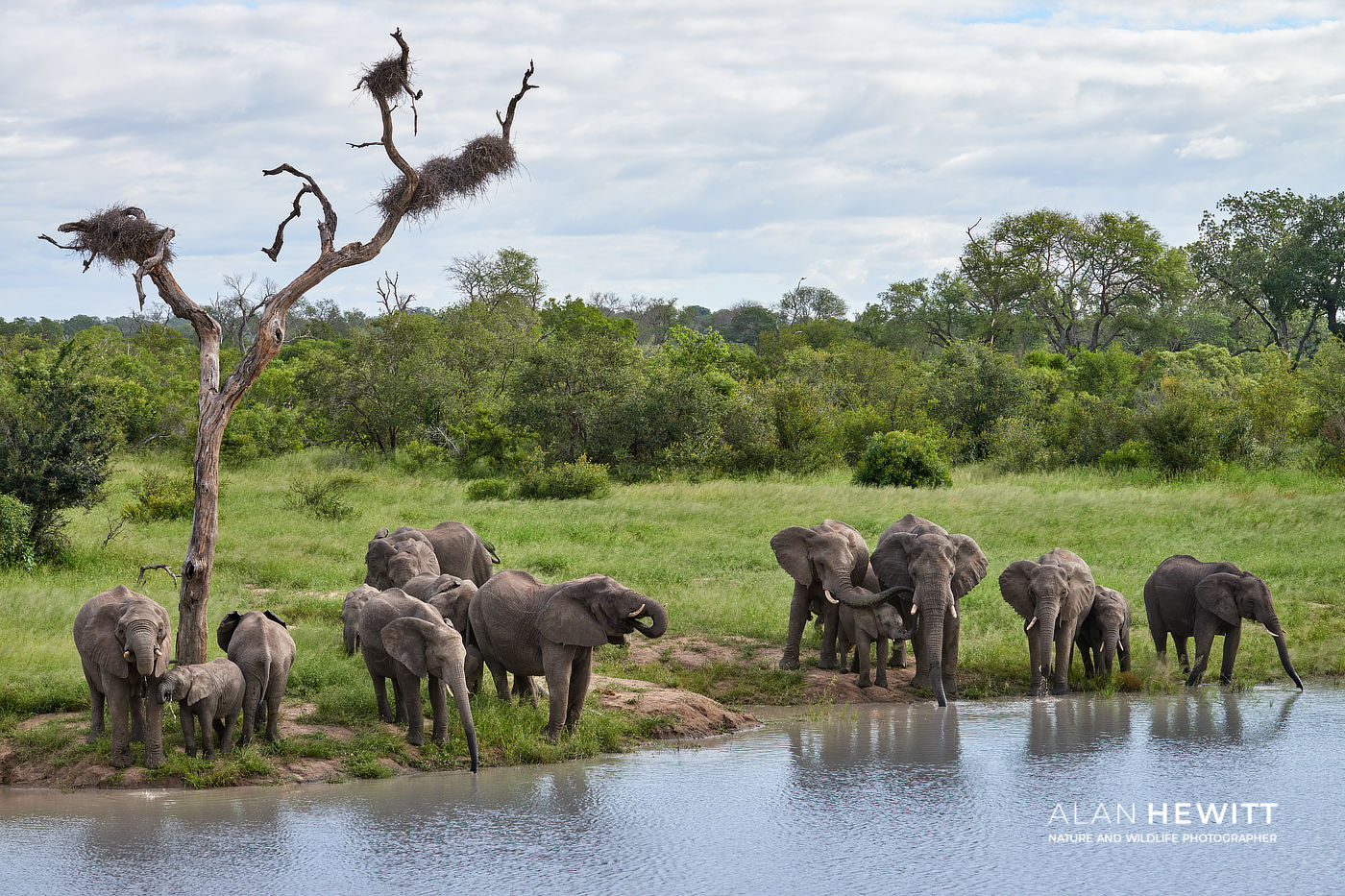
Elephants at the watering hole - AI Isn't Wildlife Photography

African Elephants, Sabi Sands.

From Blog Inspiration to Safari Adventure!
26th August 2026 & 2027
7 or 11 nights available

26th August 2026 & 2027
7 or 11 nights available

Supporting conservation and communities through ethical safaris. Join us on unforgettable photography safaris led by professional guides and photographers.

Real and witnessed in nature

I took this photograph in South Africa’s Sabi Sands reserve. We were crossing a dam when I heard splashing and I looked back to see a wonderful sight. A herd of elephants drinking at the water’s edge. A dead tree with weaver nests added another layer of life and texture to a beautiful moment.

It’s a moment that was real and witnessed in nature. It was an experience that our guests and I can cherish as a wonderful memory.

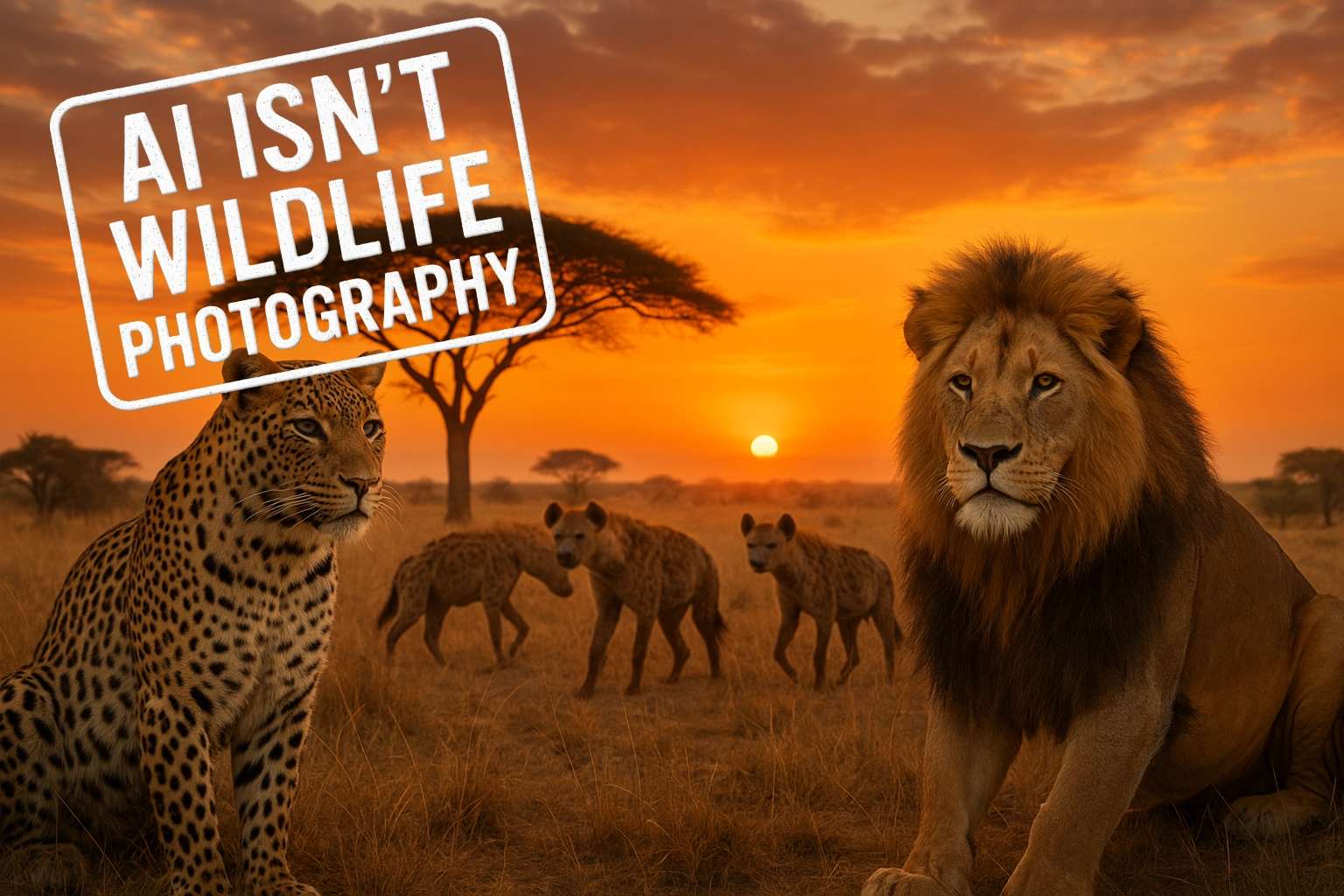
That distinction, that the scene was real, feels increasingly important to state. Our social media feeds have been inundated with artificial antelligence (AI)–generated “wildlife” images. I use that word loosely, because many of these creations depict animals and birds that don’t even exist. They’re fantasy creatures rendered by algorithms, yet they’re often presented as “Best Photo of the Day!” and tagged with #wildlifephotography, #photochallenge, or even #photographerforhire and #bestwildlifephotography.

Light falling on a photosensitive surface creates a photograph. A photographer is someone who takes photographs, not someone who types prompts into an AI image generator.

It’s not only individuals chasing clicks and social media likes who are guilty of this. Increasingly, I’ve actually seen safari companies and travel operators using AI-generated imagery for marketing purposes. Yes, trying to sell the idea of sub-Saharan Africa through fabricated animals, impossible skies, and digitally concocted moments of apex predators giving over their cubs to people for a reason I cannot begin to comprehend. That feels deeply wrong. Sorry, that is deeply wrong! Wildlife photography and responsible tourism rely on trust, truth, and on the shared wonder of real experiences and AI cannot be wildlife photography.

Why authenticity matters more than ever in nature photography

Equally troubling is how readily many viewers accept and believe these AI generated images and ‘video’ to be real. The comments sections are filled with awe and admiration for creatures that don’t exist, places that are never seen, and moments that were never lived. This isn’t harmless fantasy, it contributes to misinformation, encourages dangerous anthropomorphism, and erodes the public’s understanding of real ecosystems and conservation challenges.

AI Isn't Wildlife Photography

From a ‘sustainable safari company’ promising the wondrous spectacles and most dramatic sightings!!

When false imagery becomes normalised, it warps our collective sense of what nature truly looks like and that has consequences. If people begin to expect fantasy, the real wild starts to feel inadequate. If we invent animals instead of protecting the ones that exist, conservation loses its urgency. A digitally produced smiling lion in an AI-generated savanna will never feel the pressure from habitat degradation, the lack of water, or protection from poaching. But the real lions do. When we blur that line, I feel we risk dulling empathy, maybe even risking diverting funding, and replacing awe and awareness with apathy.

There’s no authenticity, no scientific value, and no educational merit in these AI generated scenes. They disrespect the animals they claim to celebrate and devalue the work of those who dedicate years to learning fieldcraft, understanding species behaviour, and being present in the wild.

For the record, every image you see on our website and social media is a photograph. Real and witnessed in nature. And that, to me, is still the most extraordinary kind of magic there is.
We chatted about using AI in this way in episode 16 of our African Photography Safaris podcast.

Read more

Comments

14 responses to “AI Isn’t Wildlife Photography”

  1. Dave Trethwick avatar
    Dave Trethwick

    This absolutely hits the nail on the head. I’ve seen lots of AI imagery with such hashtags and even an organisation doing accredited guide training and tour companies. It gives me no confidence at all if there relying on ai images

    1. Alan Hewitt avatar
      Alan Hewitt

      Thanks Dave

  2. leslie avatar
    leslie

    This is so right! Real photos of animals are amazing and we should always respect that. AI can’t replace them.

    1. Alan Hewitt avatar
      Alan Hewitt

      Thank you, we fully agree! Nature is real, true wildlife photography is real and witnessed and in nature.

  3. Alex Hastie avatar
    Alex Hastie

    It’s deeply suspicious for a tour company to be using AI, if I was a customer I’d be thinking why are they not using real photographs, pretty much anybody has a phone with a camera, might not be superb quality but a bit of BTS is honest and projects a more trustworthy image than resorting to ai

    1. Alan Hewitt avatar
      Alan Hewitt

      Yes Alex, those are absolutely our feelings too!

  4. Luca Blažević avatar
    Luca Blažević

    I think you make editing sound too simple. I agree AI pics that aren’t real shouldn’t trick people, but there’s a big difference between normal photo editing and totally made-up stuff. Even pro photographers change colors or crop their photos, and that doesn’t make them fake. Saying it’s either real or AI misses all the stuff in between that’s still real.

    1. Alan Hewitt avatar
      Alan Hewitt

      Thanks Luca, Perhaps I should’ve made that clearer. I’m not talking about “straight from the camera” purism versus normal raw post-processing. There’s a huge difference between the kind of editing we all do — adjusting light, colour, contrast, crop etc. and imagery that depict completely fabricated animals, behaviours or scenarios that do not happen in the real world.

  5. Thomas Edmonds avatar
    Thomas Edmonds

    I get that AI images isn’t real wildlife photography, but if it is just for social media and marketing, does it really matter?

    1. Alan Hewitt avatar
      Alan Hewitt

      Thanks for sharing your thoughts, we think it does matter, even for marketing. The problem isn’t the intention, it’s the message. AI wildlife images can give people wrong ideas about how animals behave and what’s possible in the wild. Over time, this can confuse people, weaken trust in photographers and conservationists, and even affect how animals are treated. Plus, people working in the field shouldn’t have to rely on AI to get great images real wildlife is amazing enough on its own.

  6. Kyle Create avatar
    Kyle Create

    Get a grip! We would still be using glass plates if we all had that attitude. Move with the times or stagnate.

    1. Alan Hewitt avatar
      Alan Hewitt

      I think you should read it again, Kyle. It isn’t “don’t embrace technology.” It’s about preserving what makes wildlife photography genuinely special.

  7. Kyle Van der Merwe avatar
    Kyle Van der Merwe

    Hi Alan I hope you are well, I think we have met a while back in the bush pub. Sadly the bush pub is no more. If you recall, I am a FGASA field guide and I read your thoughts here with a great deal of interest and agreement. How AI is distorting perception about real wildlife encounters is becoming an increasing worry and I’m sure that’s not just here in Kruger but will be elsewhere too.

    We’re already seeing evidence of how people are easily misled, their perception about how wildlife behaves or coexists with people is shaping unfounded fear or unsafe expectations about species encounters.

    From our perspective, we worry about how this undermines conservation education, making it harder for people to differentiate accurate behaviour from fantasy and potentially weakening support for real conservation needs.

    It has real consequences. We had an incident recently near skukuza where fake video posted online triggered lots of concerned phone calls to rangers with tourists concerned about their safety at a campsite.

    This will get worse. It is very worrying.

    Be great to have a beer with you again but we’ll have to make it in Hoedspruit! Best, Kyle lekka lad!

    1. Alan Hewitt avatar
      Alan Hewitt

      Hi Kyle, good to hear from you! We did have beersin the bush pub – seems like a long, long time ago! It saddens me every time I drive past the pile of rubble that once was the bush pub! Thank yuo for your thoughts on AI too, I absolutely agree!

Leave a Reply

Your email address will not be published. Required fields are marked *